
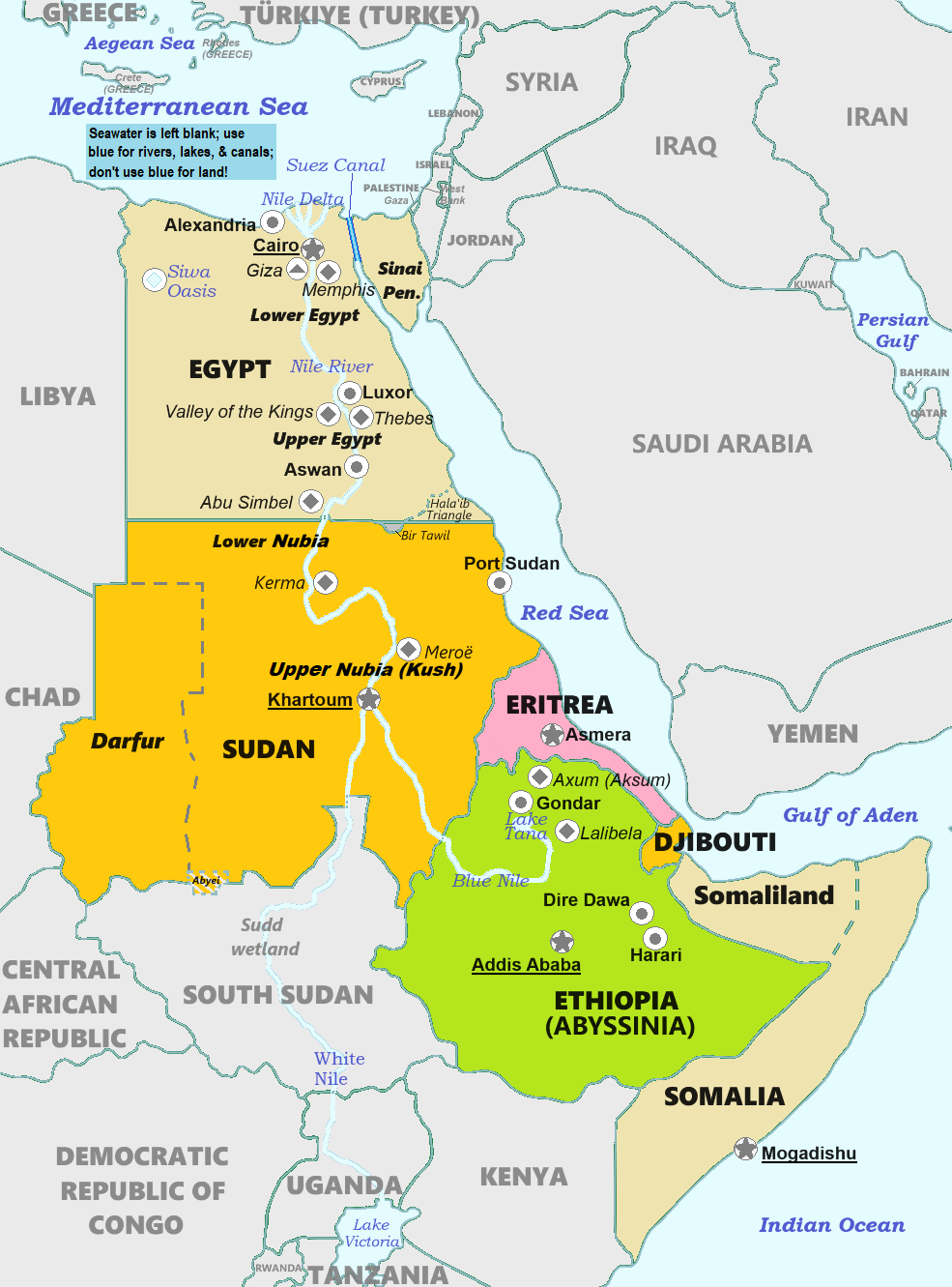
1.0 Geography
1.1 Physical Geography
-
- Physical Geography: The study of the natural features of the Earth’s surface, such as landforms, water bodies, climate, and plant life.
- Arid: Dry; of land or a climate, having little or no rain. Too dry or barren to support vegetation.
- Delta: An often triangular-shaped landform created when a river deposits sediment into a larger body of water, such as an ocean or lake, causing the river to slow down and drop its load of silt, sand, and gravel
- Inundation: The annual flooding of the Nile. Each summer, rains upstream caused the Nile to burst its banks, laying down a fresh layer of rich, fertile earth across the floodplain on both sides. The Egyptians learned to irrigate the land so that it was not too dry or too sodden after the floods. They dug channels between the fields to take water to fields that were further away from the river.
- Mirage: An optical illusion caused by atmospheric conditions, especially the appearance of a sheet of water in a desert caused by the refraction of light from the sky by heated air.
- Oasis: An area in a desert where water rises to the surface, providing moisture and allowing plants to grow in the absence of sufficient rain.
- Quicksand: A mixture of sand and water, or sand and air, that looks solid, but becomes unstable when disturbed by any additional pressure.
- Sandstorm: A strong wind carrying clouds of sand with it, especially in a desert.
- Wadi: A valley or streambed that is dry except perhaps in the rainy season.
- Xerophyte: A type of plant that can live in a desert, like a cactus. (But cactus are native to the Americas, not the Old World.) Old World examples include date palms, acacia trees, and the ghaf tree.
1.2 Waters
-
- Blue Nile: One of the two main rivers that join to form the Nile River; it starts at Lake Tana in Ethiopia and provides most of the water during the flood season.
- Faiyum Oasis: A large, fertile basin or depression in the desert west of the Nile River, which receives its water supply directly from the Nile.
- Lake Tana: A large lake in the highlands of Ethiopia that is the official source of the Blue Nile.
- Lake Victoria: The largest lake in Africa, located in East Africa, and is considered the main source of the White Nile.
- Mediterranean Sea: The large sea that borders Egypt to the north; the Nile River flows into it, forming the fertile Nile Delta.
- Nile Delta: The place where the River Nile flows into the Mediterranean Sea. In ancient Egyptian times, it divided into seven main channels and hundreds of smaller ones which fanned out across the lowlands. This triangular area of land resembled the shape of the Greek letter “delta”, so the region was known as the Nile Delta. The lands around the Nile Delta were fertile and an ideal place for farming.
- Nile River: The world’s longest river; it flows through the center of Egypt. The river flooded every year, providing fertile soil for farming. It was also vital for travelling from place to place and for transporting heavy goods.
- Red Sea: The sea that borders Egypt to the east; it was an important route for trade with Arabia and East Africa.
- Siwa Oasis: An isolated, fertile area deep in the Western Desert of Egypt, historically famous for its Temple of the Oracle (a prophet).
- White Nile: The longer of the two main rivers that join to form the Nile River; its source is generally traced to the area of Lake Victoria.
1.3 Lower Egypt
-
- Lower Egypt: The northern area of Egypt. The downstream land around the Nile River, including the Nile Delta, Cairo, Memphis, Giza, and Alexandria.
- Alexandria: The Second City of Egypt, named after Alexander the Great, best known for the Pharos Lighthouse, one of the Seven Wonders of the Ancient World, and its Great Library, the largest in the ancient world.
- Cairo: Current capital of Egypt. Its metropolitan area, with a population of over 20 million, is the largest in North Africa, the Arab world, the Middle East, and the 6th-largest in the world. “The city of a thousand minarets” for its Islamic architecture.
- Giza: A famous pyramid site, made up of three large pyramids. These are: the Great Pyramid of Khufu, the Pyramid of Khafre and the Pyramid of Menkaure.
- Memphis: Capital of the Old Kingdom. Memphis was founded about 2925 BC by the first pharaoh Narmer (Menes), who united Upper and Lower Egypt.
- Necropolis: Place of the dead; burial ground.
- Sahara: The largest hot desert in the world, about the size of the U.S., it covers North Africa, with extreme heat (122°F) and it’s very arid (dry) with very little rainfall. Name means desert.
- Saqqara: It served as a primary necropolis (burial ground) for the ancient capital of Memphis for over 3,000 years, containing numerous tombs and pyramids, most famously the Pyramid of Djoser, the world’s oldest complete stone building.
- Sinai Peninsula: A peninsula of Egypt pointing into the Red Sea, connecting Africa to Asia.
- Suez Canal: An artificial waterway in Egypt connecting the Mediterranean Sea to the Red Sea, providing the shortest maritime route between Europe and Asia, and is vital to global trade and shipping. Officially opened in 1869 after nearly a decade of construction organized by the French.
1.4 Upper Egypt
-
- Upper Egypt: The southern area of Egypt, located upstream along the Nile River, including Luxor, Thebes, the Valley of the Kings, Aswan, and Abu Simbel.
- Abu Simbel: The site where two huge temples, ordered by Rameses II, are built into a rock wall. Outside the temple are seated statues of the king. The smaller temple is dedicated to Queen Nefertiti.
- Aswan: A southern Egypt city on the Nile River at the first cataract (rapids-falls area). Downriver is Elephantine Island.
- Deshret: The ancient Egyptian name for the desert. The name means “the red land”, referring to the color of the sand.
- Egypt: Containing the end of the Nile River and the Sinai Peninsula, this is a predominantly Arabic and Islamic country in the Middle East, in the northeastern corner of Africa.
- Karnak: The site of a huge temple built to honor the god Amun-Re. The temple complex had ceremonial halls and avenues where processions took place.
- Kemet: The ancient Egyptian name for the floodplain surrounding the Nile. The name means “the black land”, referring to the dark color of the floodplain’s fertile soil. It is sometimes called the Nile Valley.
- Luxor: A modern city in Upper Egypt built on the site of ancient Thebes, which was the capital of Egypt during the New Kingdom.
- Thebes: An ancient Egyptian city on the east bank of the Nile. Thebes was the capital of Egypt during the Middle Kingdom and New Kingdom.
- Valley of the Kings: A valley near Thebes where New Kingdom pharaohs were buried in underground tombs.
1.5 Nubia
-
- Nubia: A region in modern Sudan along the Nile River between where the Blue and White Niles meet and the first cataract (rapids and falls area) of the Nile River – land of the Black African ancient kingdom of Kush, containing ancient Kerma and Meroë.
- Cataract: A large area of a river filled with rocks, small boulders, and islets, which creates shallow, rapid, and foaming water that makes navigation difficult or impossible, , a characteristic that also inspired the name for a cloudiness in the lens of the eye. The word “cataract” comes from the Greek word katarakhtes, meaning “waterfall,” and originally described a powerful rush of water.
- Darfur: A semi-desert plateau region in western Sudan. It was an independent sultanate for several hundred years until 1874, when it became part of Sudan.
- Kerma: An ancient Black African Nubian culture centered in present-day Sudan, older than the Kingdom of Kush.
- Khartoum: The capital city of Sudan, where the Blue Nile and White Nile meet to form the Nile River.
- Lower Nubia: The northern part of the region of Nubia, located south of ancient Egypt. It was a trade and cultural area along the Nile River.
- Meroë: Ancient capital of the Black African Kushite Kingdom, in Sudan’s Nile Valley, known for building over 200 pyramids.
- Nabta Playa stone circle: An ancient astronomical structure in southern Egypt, predating Stonehenge by several millennia.
- Sudan: A predominantly Arabic and Islamic country in Northeast Africa, featuring ancient Kerma, Meroë, Kush, and Nubia.
- Upper Nubia (Kush): The southern part of the region of Nubia, located upriver (south) of Lower Nubia. It was a major kingdom known by the Egyptians as Kush.
2.0 Religion
2.1 Ancient Egyptian Polytheism
-
- Polytheism: The ancient Egyptians had many different gods and goddesses (deities).
- Amun-Ra: King of all the Egyptian gods, considered the father of the pharaohs.
- Anubis: The Egyptian god of the dead, mummies and embalming. He is depicted with the head of a dog called a jackal.
- Bast (Bastet): The cat-headed goddess of protection, pleasure, and the bringer of good health.
- Ennead: A group of nine deities in Egyptian mythology worshipped at Heliopolis.
- Horus: The Egyptian god of the sky, war and protection. He was depicted with the head of a falcon and was believed to enter a pharaoh’s body when he was crowned.
- Khonsu (Khonshu): The Egyptian god of the moon.
- Osiris: The Egyptian god of the dead. He was believed to rule the Afterlife.
- Plagues of Egypt: According to the biblical Book of Exodus, these were ten disasters sent by God to punish Egypt for Pharaoh’s refusal to free the enslaved Hebrews.
- Sphinx: A mythological beast with the body of a lion and the head of a pharaoh or god. The Egyptians built sphinx statues to guard tombs. A statue in the shape of a lion with a human or ram’s head. The most famous example is the Great Sphinx at Giza.
2.2 Ancient Egyptian Deities
-
- Bes: The ancient Egyptian god (depicted as a bearded dwarf or pygmy) who was worshiped as the protector of women in labor, mothers and children, and newlyweds.
- Hathor: The Egyptian goddess of love, music, joy and beauty.
- Isis: Ancient Egyptian goddess of healing and magic. She is known today by her Greek name Isis; however, the ancient Egyptians called her Aset.
- Ma’at: The principle of truth, justice and morality that was strictly followed by the ancient Egyptians. The principle was embodied by the goddess Ma’at.
- Mut: Queen of the Egyptian gods. She was shown as a vulture or a crowned woman.
- Ra: The Egyptian god of the Sun. He was shown with a falcon’s head, carrying the disc of the Sun above his head.
- Set (Seth or Sutekh): The Egyptian god of deserts, storms, evil, darkness and war.
- Sobek: The ancient Egyptian crocodile god – the god of appetite; especially at Crocodilopolis (Krokodeilópolis) at the Faiyum Oasis.
- Taweret (Taurt): The ancient Egyptian goddess with a body and head of a hippopotamus. She was the benevolent protector of fertility and childbirth, associated also with the nursing of infants.
- Thoth: The ancient Egyptian ibis-headed god of the moon, sacred texts, mathematics, the sciences, magic, messenger and recorder of the gods, master of knowledge, and patron of scribes.
2.3 Ancient Egyptian Afterlife
-
- Afterlife: The place where people believed they would go after they died.
- Book of the Dead: A book of spells and hymns that were thought to help the dead through the Afterlife. It was written on papyrus and placed in the coffin or burial chamber of the dead person. The modern name for a collection of spells (about 200) that enabled the dead to travel through the underworld and enter the afterlife. The ancient Egyptians knew it as the ‘spells for going forth by day’.
- Burial chamber: The room in a tomb or pyramid where a mummy was placed. It was filled with objects that would be needed in the Afterlife.
- Curse of the Pharaohs: A popular idea (mostly a legend) that bad luck, illness, or death will fall upon anyone who disturbs the mummy or tomb of an ancient Egyptian pharaoh.
- Funeral: Ancient Egyptian burial involved elaborate rituals and the mummification of the deceased to ensure a successful afterlife, with burials evolving from simple pits to elaborate tombs containing grave goods, food, and even models of everyday items.
- Sarcophagus: The outer stone coffin into which a wooden coffin was laid.
- Shabti: A small figure in the shape of a mummy. Shabti were placed in tombs to act as servants in the Afterlife.
- Tomb: The place where the deceased is buried. The most famous Egyptian tombs are the pyramids, which were only used for royalty. The tomb was the eternal home for the deceased person, so the tomb usually included furniture, food, and anything else the deceased might need in the afterlife.
- Underworld: The ancient Egyptians thought of the underworld as a dangerous place through which a boat carrying the sun god and his companions, including the deceased, must travel every night.
- Weighing the Heart: An ancient Egyptian judgment ceremony where the deceased’s heart was weighed against the feather of Ma’at (truth and justice) to determine their worthiness for the afterlife.
2.4 Ancient Egyptian Mummification
-
- Mummification: The process of preserving a body. It was carried out by people called embalmers. First they removed all the inner organs except for the heart, placing them in canopic jars (except for the brain, which was discarded). Next, they packed the body with salt, sand and spices and rubbed it with oils and resin, before wrapping it in layers of long linen bandages. It took about two months to mummify a body.
- Canopic jars: Funerary jars containing organs removed from the mummy. These were made in sets of four to contain the lungs, stomach, liver and intestines. Decorated jars inside which a mummy’s internal organs were stored. In the New Kingdom they took the form of the four sons of Horus: a man, a falcon, a jackal, and a baboon.
- Death mask: A highly-decorated mask placed on a mummy to guard the soul from evil on its journey to the Afterlife.
- Embalm: To preserve a body from decay.
- Mummy Bandages: Strips of linen wrapped around a deceased body to protect it, showcasing the importance of linen in religious practices.
- Mummy: A body that has been preserved after death and then wrapped in linen cloth bandages.
- Myrrh: An aromatic (good-smelling), bitter-tasting gum resin that seeps from the Commiphora myrrha tree. It has ancient medicinal uses, including wound dressing and pain relief, and contains compounds with antiseptic, anti-inflammatory, and painkilling properties.
- Natron: A natural salt used to dry out bodies during mummification.
- Obsidian knife: A blade, made from glassy volcanic rock obsidian, called by the Egyptians “Ethiopian Stone.” It was traditionally used to open the abdominal cavity of a body during the process of mummification.
- Resin: A sticky substance that comes from tree sap and was used for embalming, among many other uses.
2.5 Ancient Egyptian Sacred Animals
-
- Baboon: Large, ground-dwelling monkeys with powerful jaws. Revered animals, closely associated with the moon god Thoth, the deity of wisdom and writing, as well as the sun god.
- Cat: Felines. Revered companions, protectors, and divine symbols associated with goddesses like Bastet, leading to their widespread practice of mummification and veneration.
- Crocodile: Large, semi-aquatic reptiles with thick scaly skin and powerful jaws with many teeth. They were revered and feared by the ancient Egyptians. They were associated with the god Sobek, the deity of the Nile, fertility, and protection.
- Dog: Canines. Companions, hunters, and guardians and were depicted in tombs, with some being mummified and buried with their owners to accompany them into the afterlife.
- Egyptian cobra: The cobra goddess Wadjet represents Lower Egypt.
- Griffon vulture: The white griffon vulture goddess Nekhbet represents Upper Egypt.
- Hippopotamus: Large, barrel-shaped, semi-aquatic mammal, representing both the life-giving fertility of the Nile and the destructive, chaotic force of the wild.
- Ibis: A large wading bird with a long down-curved bill, long neck, and long legs. A symbol of Thoth, the god of wisdom, writing, and knowledge.
- Jackal: Dog-like canids, characterized by their small faces, long legs, long ears, and bushy tails; deeply connected to death and the afterlife.
- Scarab: A dung beetle that was a sacred symbol of new life and regeneration.
3.0 Achievements & Economy
3.1 Ancient Egyptian Agriculture
-
- Agriculture: Growing plants and raising animals for human use, providing us with food and other products. It involves cultivating (preparing) soil to grow crops, like vegetables and grains, and raising animals for food, wool, and other materials. This practice has allowed human populations to grow into towns and cities by creating a stable supply of food, beverages, and fiber for clothing.
- Barley: A grain grown for making beer. It requires less fertile soil than emmer or wheat, and grows faster, but is harder to prepare as food.
- Cotton: Cotton was present and used in ancient Egypt as far back as the Dynastic period, though it was not a commercially significant crop until much later.
- Emmer: A type of wheat grown in ancient Egypt. It was used for making bread.
- Lotus: The divine flowers of the gods; they represent death and re-birth by closing each night and reopening each morning. The flowers provided the scent for the first perfume, as well as the perfumed cones that also contained the insect repellent citronella.
- Papyrus plant: A reed that grows along riverbanks and can be used to make every day utensils, boats and a material for writing on.
- Reed boat: A simple boat made from bundles of papyrus tied together. Reed boats had wooden paddles or long poles.
- Shadoof (or shaduf): A pole with a bucket and counterweight used to raise water for drinking and irrigation.
- Wheat: A type of grain that was a major food crop in ancient Egypt, used to make bread.
- Yield: The amount of agricultural product, such as grain, fruit, or vegetables, harvested from a specific unit of land area, typically measured in units like bushels per acre.
3.2 Ancient Egyptian Architecture
-
- Architecture: The art and science of designing and constructing buildings and other structures.
- Adobe (mud brick): Building bricks made of a mixture of earth and water, with organic fiber added as a binder.
- Capstone: The pyramid-shaped stone at the top of a pyramid, also called a pyramidion.
- Egyptian Revival architecture: An architectural style that incorporates motifs and imagery from ancient Egypt, inspired by archaeological discoveries and Napoleon’s campaigns, with symbols like the sphinx, scarab beetle, lotus flower, and hieroglyphs.
- Masons: A skilled tradesperson who built with stone and brick to construct buildings, walls, and other structures.
- Minaret: A tower often built to adorn a mosque, from which the call to prayer may be sounded.
- Obelisk: A tall stone pillar with a small pyramid at its top. The Egyptians placed obelisks at the entrances to their temples.
- Plumb bob (plumb line): A weight attached to a string used by craftsmen to determine a straight vertical line.
- Quarry: To cut into (rock or ground) to obtain stone or other materials.
- Stela (plural stelae): Greek for pillar. An upright slab of stone carved and inscribed with religious or historical texts and representations.
3.3 Ancient Egyptian Pyramids
-
- Pyramid: A pharaoh or queen’s stone tomb with four sloping triangular sides. The pharaoh’s body was placed in the pyramid, alongside his treasures. The entrance was then sealed to deter robbers. It took thousands of workers more than 20 years to build one pyramid.
- Mastaba: A rectangular, flat-topped tomb made from mud-bricks and stone. Mastabas were used for the burial of high-ranking individuals.
- Step Pyramid of Djoser: The 6-tier, 4-sided structure is the earliest colossal stone building in Egypt.
- Meidum Pyramid: An early experimental step pyramid that became unstable, the first one built for Pharaoh Sneferu.
- Bent Pyramid: A pyramid built at Dahshur, which changed its angle mid-construction to achieve structural stability, the second one built for Pharaoh Sneferu.
- Red Pyramid: A pyramid built at Dahshur, the first successful “true pyramid” with straight sides and a square base, which became the template for the Great Pyramid of Giza, the third one built for Pharaoh Sneferu.
- Great Pyramid of Khufu: The largest of the pyramids at Giza. It was 147 metres (482 feet) high. It is the only one of the Seven Wonders of the Ancient World still standing today.
- Pyramid of Khafre: The second-tallest and second-largest of the three Great Pyramids of Giza.
- Casing stones: The outer layer of a pyramid, mostly made from limestone blocks. Casing stones would be highly polished.
- Pyramidion: The capstone of an Egyptian pyramid or the upper section of an obelisk.
3.4 Ancient Egyptian Hieroglyphics
-
- Hieroglyphics: The ancient Egyptian writing system of picture symbols, used for official and ceremonial purposes, such as inscriptions in burial chambers.
- Amphora: A large pottery or stone vessel, usually with one or more handles and used as storage or transport container for liquids or solids, such as vegetable oils and wine. (Original use of at-symbol.)
- Cartouche: Oval band, symbolizing continuity, which enclosed a god or pharaoh’s name.
- Demotic: The normal, everyday writing used by the Egyptians in the later years of their civilization.
- Hieratic: The normal, everyday form of writing used by ancient Egyptians. It was a simplified form of hieroglyphics and was much quicker to use.
- Hieroglyphs: Individual picture symbols of the ancient Egyptian writing system.
- Papyrus paper: The writing surface for Egyptian scribes. It is made from the pith of the stalks from papyrus plants.
- Polymath: A person of wide-ranging knowledge or learning.
- Rosetta Stone: A special stone that had the same inscription written both in Greek and in Egyptian hieroglyphics. It was very helpful in translating and understanding hieroglyphics.
- Senet: A board game played by the Ancient Egyptians.
3.5 Ancient Egyptian Art
-
- Alabaster: Translucent, usually white, form of gypsum carved into ornaments and pots.
- Amulet: A charm worn like jewelry believed to provide protection against evil or injury, worn by the living or wrapped with mummies to guard them on their journey through the underworld and protect them in the afterlife.
- Ankh: A hieroglyphic sign for life similar to a cross but with a loop in place of the upper arm. It was often produced in solid form and worn as jewelry.
- Cedar: A tree from the land of Lebanon that produced wood that was good for building. The Egyptians used cedar wood to build their ships.
- Cosmetics: In ancient Egypt, men and women used nail polish on both finger and toe nails; kohl was ground to create eye makeup that helped protect from the sun; lipstick was usual for, as were false eye lashes, wigs, and perfume. Q-tip shaped metal or wood tools were used for applying cosmetics.
- Crook: A gold-plated shepherd’s crook carried by the pharaoh during religious ceremonies. It was a symbol of his duty to protect his people.
- Flail: A gold, whip-like farming tool, carried by the pharaoh during ceremonies. It was a symbol of his power to punish enemies.
- Lapis lazuli: A prized blue stone imported from as far as Afghanistan, for jewelry, amulets, and decorative inlays, believing it symbolized royalty and divinity.
- Was Scepter: An ancient Egyptian symbol of power, dominion, and a safe passage to the afterlife, represented by a staff with a forked tail.
- Wedjat eye (or Udjat eye): Eye of Horus. An eye with stylized falcon markings meaning ‘that which is made whole’. It is the symbol of the left eye of Horus, torn out by Seth in their battle over who should rule Egypt. It is the symbol of revitalization after death.
4.0 Politics & Society
4.1 Peoples
-
- Egyptians: The people of Egypt, especially those living in the Nile Valley. (In this context, often refers to the non-Arab, indigenous inhabitants).
- Arabs: A major ethnic group that speaks Arabic and became the dominant cultural and ethnic group in Egypt after the 7th century CE.
- Bedouin: Nomadic or semi-nomadic Arab people who traditionally live in the deserts of North Africa and the Middle East.
- Hebrews: The ancient people who lived in the Near East and are known today as the Jewish people; they were supposedly enslaved in Egypt before the Exodus.
- Hyksos: A little understood Asiatic people that conquered Lower Egypt for a time. They brought superior weapons and the chariot.
- Medjay: A group of people from ancient Nubia who were often employed by the Egyptian government as desert scouts, soldiers, and police.
- Nubians: Black Africans to the south of Egypt. The Nubians flourished through trade with Egypt. Nubia was controlled by Egypt for much of the New Kingdom.
- Tuareg (Berbers): Indigenous (native) nomadic people of North Africa and the Sahara Desert; they are related to the wider Berber ethnic group.
4.2 Rulers
-
- Narmer (Menes): Probably the first pharaoh to rule both Upper and Lower Egypt. He is believed to have conquered Lower Egypt in about 3100 BC and brought the two kingdoms together.
- Zoser (Djoser): An ancient Egyptian pharaoh known for his step pyramid, which is the earliest colossal stone building in ancient Egypt.
- Imhotep: The architect of the first Egyptian pyramid. He was also the second in command after the pharaoh and was later made into a god.
- Sneferu: A pharaoh who built three main pyramids, serving as a crucial evolutionary step in ancient Egyptian pyramid construction: the Meidum Pyramid, an experimental step pyramid that became unstable; the Bent Pyramid at Dahshur, which changed its angle mid-construction to achieve structural stability; and the Red Pyramid at Dahshur, the first successful “true pyramid” with straight sides and a square base, which became the template for the Great Pyramid of Giza.
- Khufu: Old Kingdom pharaoh who was famous for commissioning the Great Pyramid of Giza, also known by his Greek name, Cheops.
- Hatshepsut: Queen of Egypt from 1478 to 1458 BC. When her husband Thutmose II died, she took power and was made pharaoh. She wore the traditional clothing of a male pharaoh, including a false beard.
- Akhenaten: Pharaoh of Egypt from 1348 to 1338 BCE. He tried to make people abandon their many gods and worship only Aten, the Sun in the sky. He was probably the father of Tutankhamun.
- Queen Nefertiti: Queen of Egypt, she ruled beside her husband Akhenaten. After her husband’s death, some scholars believe Nefertiti may have ruled as pharaoh in her own right for a short time. She died around 1334 BC.
- Tutankhamun: Pharaoh of Egypt from 1336 to 1327 BC. Tutankhamun is sometimes called the Boy King because he was only 19 when he died. His tomb was discovered intact in the Valley of the Kings in 1922.
- Seti I: A pharaoh of the New Kingdom (19th Dynasty) and the father of Ramses II. He was a great builder and military leader.
- Ramesses II: The second of twelve pharaohs of ancient Egypt carried the name Ramesses, meaning “born of the Sun god Re”. The most famous was Ramesses II, or Ramesses the Great, who ruled from 1279 to 1213 BCE. Ozymandias was the Greek name for Ramesses II, and the title of a famous poem by Percy Bysshe Shelley, from 1818.
- Cleopatra: Queen of Egypt from 51 to 30 BC and the last pharaoh before Egypt was conquered by the Romans.
4.3 Timeline
-
- Dynasty: A period of rule when a series of kings or pharaohs all came from the same family.
- Pre-Dynastic Period: The period of Egyptian history (before 3100 BCE) when the first kings had not yet united Upper and Lower Egypt into a single nation.
- Old Kingdom: A period of time in ancient Egypt’s history from about 2575 to 2134 BC. During this time, the belief in the Afterlife became an important part of Egyptian religion. This was the age of pyramid-building.
- First Intermediate Period: A time in ancient Egyptian history (around 2181–2055 BCE) when the central government was weak and local leaders held most of the power.
- Middle Kingdom: A period of time in ancient Egypt’s history from about 2040 to 1640 BC. During this period, Egypt traded widely and conquered Nubia.
- Second Intermediate Period: A period (around 1650–1550 BCE) when a foreign group called the Hyksos took control of a large part of Lower Egypt.
- New Kingdom: A period of time in ancient Egypt’s history from about 1560 to 1070 BC. During this period, the “Golden Age” of Egypt, the pharaohs conquered much land and made their kingdom prosperous. New Kingdom pharaohs were buried in underground tombs instead of in pyramids.
- Third Intermediate Period: A time (around 1070–664 BCE) when Egypt was again politically divided and ruled by different groups, including Libyan and Nubian kings.
- Ptolemaic Dynasty: The last dynasty of ancient Egyptian rulers (305–30 BCE); it was founded by a Greek general of Alexander the Great and ended with Cleopatra VII.
- British protectorate: A period (1914–1922) when the British government had control and protection over Egypt, even though Egypt still had its own local rulers.
4.4 Ancient Egyptian Social Hierarchy
-
- Pharaoh: The king, high priest, and ruler of ancient Egypt. The Egyptians believed that the pharaoh was descended from the Sun god, Re, and that the spirit of the falcon god Horus entered the pharaoh when he was crowned.
- Vizier: The person responsible for the day-to-day running of Egypt. He collected taxes and administered justice.
- Noble: The wealthy, elite upper class—including government officials, military leaders, landowners, and high priests—who held immense power, wealth, and influence below the pharaoh.
- Priest: Religious leaders responsible for mediating between the people and the gods by performing daily rituals in temples.
- Scribe: A person trained to read and write in ancient Egypt. Written records were vital to the way Egypt was governed. All government officials, priests, army generals as well as the pharaoh himself, knew how to read and write. In the cities, classes were set up for scribes. Only the sons of wealthy families went to school.
- Merchant: People who traded essential goods like papyrus, linen, gold, and grain with regions like the Levant, Nubia, and the Mediterranean for imports such as cedar wood, ebony, silver, copper, and fine wines and oils.
- Artisan: Skilled craftspeople like stone masons, jewelers, potters, and weavers who created everything from monumental temples to everyday items.
- Peasant farmer: Ancient Egyptians who formed the lowest social class. Their lives were a constant cycle of back-breaking labor, including plowing, planting, and harvesting, maintaining irrigation canals, and being conscripted for national service on projects like pyramid building. Peasants lived in simple mud-brick houses and were unable to move up the social hierarchy.
- Soldier: Ancient Egyptian soldiers were often conscripted (forced to join) peasants equipped with basic weapons like spears, bows, and shields, but professional soldiers with elite units like the Medjay emerged, particularly during the New Kingdom.
- Enslaved person: Prisoners of war, debtors, and those who committed crimes were enslaved. These individuals did agricultural and construction work, to domestic and temple servant roles.
4.5 Ancient Egyptian Textiles
-
- Textiles: Cloth-like item made from fibers, including clothing (like tunics and dresses), home furnishings (like carpets and blankets), and functional uses (like tents, sails, nets, and ropes).
- Fiber: Natural or synthetic (modern, human-made) materials used to make textiles.
- Flax: A plant used to make linen textiles, processed by soaking, drying, and beating.
- Linen. The most common fabric, made from the flax plant, which grew abundantly near the Nile. It was prized for being lightweight and cool in the hot climate.
- Loom: A device used for weaving fabric; Mesopotamians and Egyptians used both horizontal and vertical looms.
- Spinning: The process of twisting fibers (like flax) together to create yarn or thread, often done with a spindle.
- Spindle: A slender, weighted rod used to twist raw fibers (like linen and wool) into thread.
- Tunic: A simple, shirt-like garment that reached the knees. The body garment was loose-fitting for men, usually beginning at the neck and ending above the knee. A woman’s garment could be either close fitting or loose, beginning at the neck and extending over a skirt or skirts.
- Kalasiris: The quintessential (perfect, typical, or pure example of) ancient Egyptian form-fitting sheath dress, supported by one or two shoulder straps, usually sleeveless, worn by women down to the ankles, usually made of linen.
- Natural colors: Linen in ancient Egypt was naturally white or light beige; dyeing was rare, though sometimes blue or red were used.