1.0 Geography
1.1 Natural Features
-
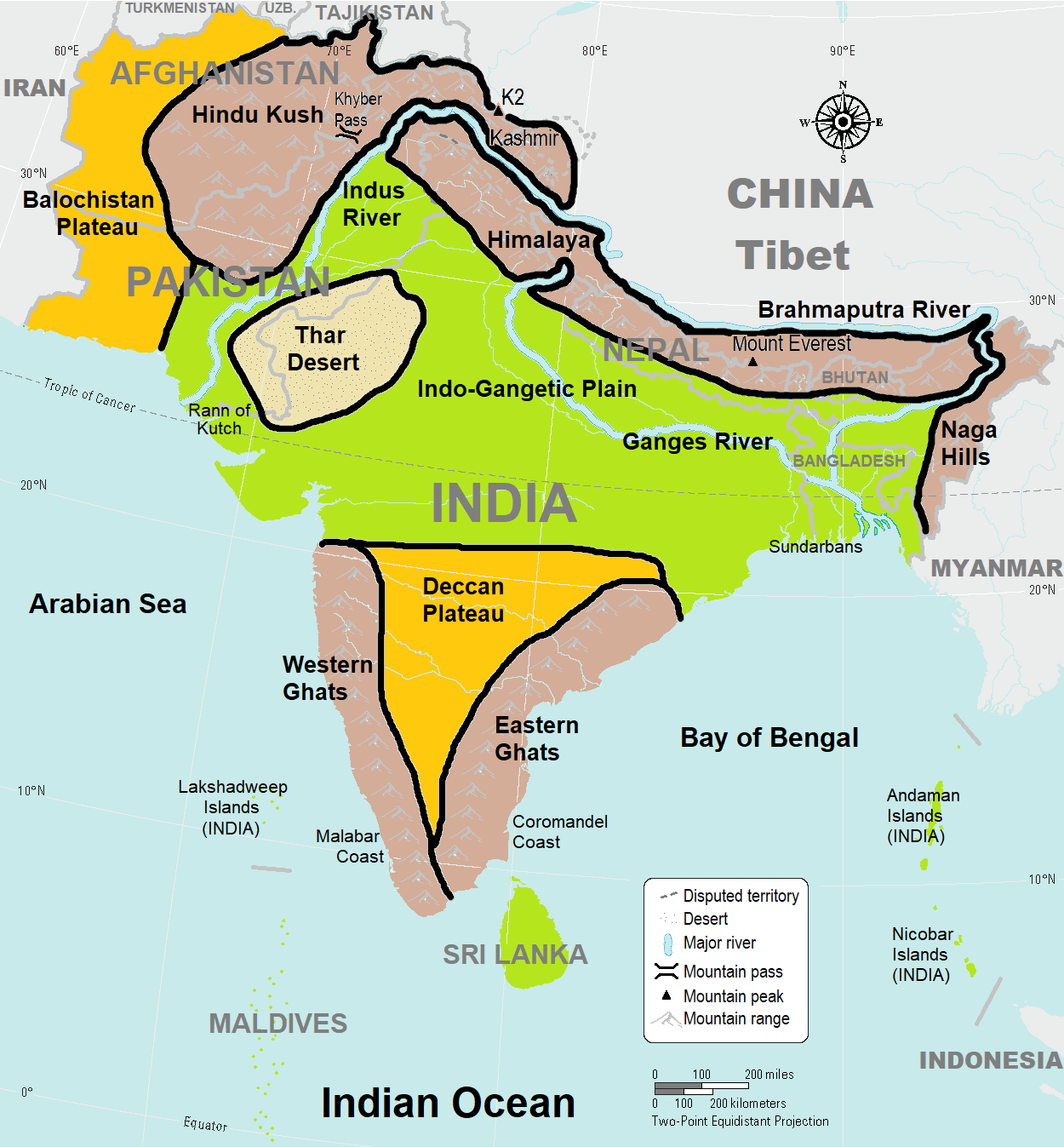
- River: A natural waterway. Good for civilizations as a source of water for drinking, crops, livestock, and washing; also a good source of silt for farming, mud for building, transportation for travel and trade, as well as fishing.
- Indus River: One of the longest rivers in Asia, crucial to the earliest civilizations on the subcontinent (the Indus Valley Civilization). It primarily flows through Pakistan.
- Ghaggar-Hakra Rivers: An intermittent river in India and Pakistan that flows in force only during the monsoon season. It is believed to be the old Saraswati River.
- Saraswati River: A large river system that once ran parallel to the Indus River, where many Indus Valley Civilization settlements were located. Its mysterious drying up, possibly due to climate change or earthquakes, is a major theory for the civilization’s decline.
- Indus Valley: The watershed basin of the Indus River, home to the ancient Indus Valley Civilization.
- Ganges River (Ganga): A major river flowing through northern India into Bangladesh. It is considered a holy river by Hindus and is vital for agriculture and life in the plain.
- Indo-Gangetic Plain: A huge, flat, and extremely fertile region south of the Himalayas. It was created by the alluvial deposits (rich soil left behind by rivers) of the Indus, Ganges, and Brahmaputra river systems.
- Brahmaputra River: A major river that flows through Tibet, India, and Bangladesh. It often joins the Ganges to form a massive delta.
- Arabian Sea: The large body of water that borders the subcontinent to the west. Named for a prominent peninsula of the Middle East.
- Bay of Bengal: The large body of water that borders the subcontinent to the east. Shares its name with a type of tigers.
1.2 Natural Barrier
-
- Natural barrier: A geographic feature like deserts and mountains (such as the Himalaya Mountains to the north) that make travel and invasion difficult.
- Himalayas: The world’s highest mountain range, forming a massive natural wall along the northern border of the subcontinent. They were created by the Indian tectonic plate crashing into the Eurasian plate.
- Hindu Kush: Major mountain system of Central Asia, including Afghanistan, Pakistan, and Kashmir.
- Khyber Pass: The mountain pass through the Hindu Kush that has connected the Indian subcontinent to western Asia for centuries.
- Thar Desert: Great Indian Desert. A large, arid (dry) desert region located in the northwest part of the Indian subcontinent, mainly in India and partially in Pakistan.
- Plateau: An elevated (raised) area of land that is flatter than a mountain.
- Balochistan Plateau: The vast, arid plateau region in Pakistan bordering Iran.
- Deccan Plateau: A large, raised, flat area (a plateau) in the southern part of India, shaped like a triangle. It is made of ancient, hard rock.
- Eastern Ghats: The broken and lower mountain range running along India’s eastern coast. They are often cut through by major rivers flowing to the Bay of Bengal.
- Western Ghats: The mountain range running along India’s western coast. They are known for blocking the monsoon winds, which causes heavy rain on the coast and drier conditions inland.
1.3 Physical Geography
-
- Climate change: A long-term shift in typical weather patterns; this could mean a place gets much hotter, colder, wetter, or drier over many years.
- Intermittent: Starting, stopping, and starting again; not constant or steady. Used to describe rivers and lakes that occasionally have water and are often dry.
- Landlocked: A country that is completely surrounded by land, with no direct access to the sea. Nepal and Bhutan are landlocked countries in the Himalayas.
- Monsoon: A seasonal change in wind direction that brings heavy rain to South Asia.
- Pass: A break or gap in a mountain range that makes it possible to travel through. Historically, mountain passes in the northwest, like the Khyber Pass, were routes for traders and invaders.
- Rain shadow: A dry area on the leeward side (the side facing away) of a mountain range. The Western Ghats cause a rain shadow effect, leading to drier conditions in parts of the Deccan Plateau.
- Subcontinent: A very large, distinct landmass that is part of a continent but is geographically separated, usually by mountains or a unique tectonic plate. The Indian subcontinent includes countries like India, Pakistan, and Bangladesh.
- Tectonic plate: Giant, moving slabs of the Earth’s outer crust. The Indian Subcontinent sits on its own Indian Plate, whose movement formed the Himalayas.
- Tropic of Cancer: The important line of latitude (≈23.5∘ North of the Equator) that passes roughly through the middle of India, separating the tropical south from the subtropical north.
- Xerophyte: A type of plant that can live in a desert, like a cactus. (But cactus are native to the Americas, not the Old World.) Old World examples include date palms, acacia trees, and the ghaf tree.
2.0 Religion
2.1 Indus Valley Religion
-
- Indus Valley Religion: The religion of the Bronze Age Indus Valley Civilization is believed to include: 1) no temples, 2) no priest class, 3) no known gods (except possibly a pre-Shiva god), 4) maybe a fertility mother goddess, 5) yoga, 6) reverence of bodhi trees/nature, and 7) ritual bathing at the Great Bath at Mohenjo-daro.
- Bodhi trees: Sacred fig, peepal, Ficus religiosa
- Fertility: The ability of soil to sustain plant growth.
- Figurine: A small sculptured model of a person, animal, or deity. The large number of terracotta (clay) female figurines suggests the worship of a Mother Goddess.
- Great Bath of Mohenjo-daro: A huge, watertight, brick-built public pool found in the Citadel of Mohenjo-daro. It was likely used for ritual bathing (religious ceremonies).
- Mother Goddess: Clay figurines of women found throughout the Indus Valley. Archaeologists believe these figures suggest the Harappans may have worshipped a fertility goddess who governed life and harvest.
- No state religion: The government or ruling body did not establish one official religion that everyone had to follow. State in this context means official or governmental.
- Religious purification: The act of cleansing oneself (like through bathing) or an object to become spiritually clean or holy before a ritual or prayer.
- Ritual: A set of actions performed in a fixed order, especially as part of a religious or solemn ceremony.
- Worshiping nature: Showing great respect, honor, or devotion to the natural world, such as rivers, trees, or mountains, often treating them as gods or spiritual entities.
2.2 Early Hinduism
-
- Hinduism: A religion and way of life that originated in India. It is the world’s third-largest religion, with over 1 billion followers.
- Hindu: A person who follows Hinduism.
- Deity: A god or goddess. Plural: deities.
- Ritual bath: A central practice in Hinduism for both physical and spiritual purification, symbolizing renewal and cleansing. Practices include bathing in sacred rivers like the Ganges, performing pre-shower oil massages (abhyanga), and chanting mantras to purify the body and mind. These rituals are performed at various times, such as daily, before festivals, or after a death.
- Sacred fire: Often called Agni, is a central element in rituals like the Vedic yajna (fire sacrifice), symbolizing divine presence, purification, and transformation. The fire is considered a messenger to the gods, serving as a medium through which offerings and prayers are delivered to the divine realm. It is invoked in ceremonies from daily household rituals to important life events like weddings and cremation.
- Agni: Fire god.
- Sarasvati: The Goddess of learning, arts, and music, often depicted seated on a white swan and holding a vina, a stringed musical instrument.
- Shiva: In Hinduism, the “Lord of the Universe,” seen as both creator and destroyer.
- Vedas: Sacred wisdom of the four Vedic collections (Shruti, “That which is heard”.)
- Yoga: A practice that involves the mastery of bodily postures, control of breathing, the cultivation (development) of mental concentration, and ethical restraints (such as non-violence, truthfulness, non-stealing, self-restraint, etc.)
2.3 Sanskrit Swastika vs. Nazi Symbol
-
- Sanskrit Swastika: An ancient, sacred symbol in the Indus River Valley Civilization, Hinduism, Buddhism, and Jainism, from the Sanskrit (ancient, classical language of India) for well-being; a mark of good fortune. The four arms signify the four directions, the four Vedas (knowledge) and the four stages (time) in the life cycle. Not to be confused with the Nazi symbol.
- Nazi vs. Sanskrit Swastika: While the Sanskrit swastika is an ancient symbol with diverse meanings across cultures, the Hakenkreuz is a specific, modern, and hate-filled symbol that became associated with Nazism, its ideology of hate, and its atrocities. You are not allowed to use it on school property under any circumstance.
- Nazi flag: Introduced in 1920, the official Nazi flag featured a red background, white circle, and a black, angled Nazi swastika. Beyond its use on the the flag the Nazi swastika was usually black and angled, but some variants were used.
- Hakenkreuz (Nazi swastika): The German word for the usually black and angled swastika that was used by the Nazi party and Neo-Nazis, which translates to “hooked cross”.
- Hooked cross (Nazi swastika): The English translation for the German word Hakenkreuz, which refers to the usually black and angled swastika that was used by the Nazi party and Neo-Nazis.
3.0 Achievements & Economics
3.1 Accomplishments
-
- Bronze Age: The historical period (roughly 3300 BCE to 1200 BCE) when people began using bronze (a metal alloy of copper and tin) to make tools and weapons, marking a huge technological step forward.
- Bronze: A strong metal made by mixing (alloying) copper and tin, commonly used for tools and statues in this period.
- Metallurgy: The branch of science and technology concerned with the properties of metals and their production and purification. The Harappans were experts at using copper, tin, and bronze.
- Quarry: To cut into (rock or ground) to obtain stone or other materials. The Indus Valley Civilization extensively used quarries, particularly for extracting flint from present-day Sindh, Pakistan.
- Bananas: Bananas are included in lists of crops grown by the Indus Valley people, such as wheat, barley, and cotton.
- Beadwork: Decorative items or designs made using small, pierced materials (beads) strung together or sewn onto fabric.
- Cotton cultivation: The Indus Valley people were among the first in the world to grow and harvest cotton, spinning it into thread to make cloth for clothing, proving their agricultural innovation.
- Lost wax technique: An advanced technique (also called cire perdue) used to make bronze statues, like the famous Dancing Girl. A wax model is melted out of a clay mold and replaced with molten metal.
- Standardized weights: Stone cubes and small stones of specific, uniform sizes found in the ruins. Their consistent weight across the entire civilization proves a highly organized system of trade and taxation.
- Trade network: The extensive routes and systems used by the Harappans to exchange goods (products to be bought and sold) like beads, copper, and cotton with distant civilizations like Mesopotamia (modern-day Iraq) and the Persian Gulf.
3.2 Water Management
-
- Water management: The planning, developing, distributing, and use of water resources in a sensible and efficient way.
- Drainage system: A complex system of covered channels and pipes built under the streets of Indus Valley cities to carry away wastewater. This showed a high priority on hygiene (cleanliness).
- Hydraulic engineering: A field of civil engineering focused on designing and managing systems for controlling the flow and pressure of water, such as pipes, wells, and dams. The IVC excelled at this.
- Hygiene: Practices, like regular washing, that help to maintain health and prevent disease.
- Manhole: Holes the size of a person that provided access to Indus Valley Civilization’s advanced underground drainage and sanitary sewer systems, which were covered by removable stone or brick slabs.
- Sanitation sewers: Underground pipes or channels designed to carry away human waste and wastewater from buildings.
- Septic tank: A large, buried container that holds and begins to break down sewage waste from a house or building.
- Sewers: Underground tunnels or pipes for carrying away drainage water and waste material.
- Stepwells: Deep wells or ponds accessed by a long set of steps, used to collect and store water.
- Wells: Deep holes dug into the ground to reach underground water.
3.3 Indus Valley Civilization Writing
-
- Writing system: A set of visible or tactile signs (like letters or symbols) used to represent the elements of a language.
- Indus script: The writing system used by the Harappan people, found mostly on their seals. As of today, historians and archaeologists cannot decipher (translate) it, leaving many mysteries about the civilization.
- Indus seal: Small, carved stone objects (usually made of steatite, a soft stone) with images of animals (like the unicorn bull) and a form of writing. They were used to stamp clay to mark property or trade goods.
- Indus unicorn: The most common motif on Indus stone seals and appears to represent a mythical animal.
- Clay seal impression: Impressions were made by stamping carved seals, typically made of steatite, into wet clay, creating a personal signature and leaving a mark that could indicate the sender, the goods being shipped, or a symbol of authority.
- Motif: Stone seal drawings, primarily animals, with the most common being the “unicorn,” a single-horned creature, followed by other large animals like zebu bulls, elephants, rhinoceroses, and tigers.
- Pashupati Seal: One of the most famous seals found, showing a seated, horned figure surrounded by animals. Many scholars believe this may represent an early form of the Hindu god, Shiva (Lord of the Animals).
- Steatite: A soft, easily carved stone (also called soapstone) used extensively by the Harappans to create their famous seals and small sculptures like the Priest-King figure.
- Undeciphered: A language or writing system that has not yet been translated or understood.
- Zebu: A type of domesticated humped cattle of India, often shown on the Harappan seals. They were important for farm work (pulling carts/plows) and were likely a religious symbol.
4.0 Politics
4.1 City Building
-
- Architecture: The art and science of designing and constructing buildings and other structures.
- Burnt brick streets: The Indus Valley Civilization used burnt bricks extensively for their streets, which were laid out in a planned grid with advanced drainage systems. Burnt bricks were more resistant to long-term water exposure, which was a key factor in the expansion of cities into flood plains.
- City walls: Large, strong barriers built around a city for defense and protection against invaders or floods.
- Dockyard: A complex structure found at the city of Lothal (on the coast) designed to hold ships and boats. This is strong evidence that the Harappans engaged in extensive maritime (sea) trade.
- Granary: A large storage building for threshed grain (like wheat and barley). Granaries in the Indus Valley cities suggest organized collection and distribution of food.
- Grid pattern: The specific, planned layout of the major cities where main streets ran straight, crossing each other at perfect right angles (like a checkerboard). This is a core feature of their urban planning.
- Lower town (lower city): The larger, eastern section of Harappan cities where the common people lived. The houses here were also built on the grid and included private wells and plumbing.
- Oriented to cardinal points: Buildings or streets that are carefully lined up to face the main directions: North, South, East, and West.
- Standardized burnt bricks: Bricks that were cooked in a high-temperature kiln (oven), making them very hard and durable. The bricks were often produced with a standard ratio of 4:2:1 (length:width:height) and were used in a standardized manner across cities, a sign of advanced engineering
- Citadel (acropolis): A large, raised area built on a high platform in the western part of the major Indus Valley cities (like Harappa and Mohenjo-daro). It likely contained important public buildings or administrative offices.
4.2 City Planning
-
- City planners: People who design and decide on the layout of a city, including where roads, buildings, and public spaces will be located.
- City trees: Trees planted and maintained within an urban area, possibly to provide shade, fruit, or beauty.
- Clean cities: Urban areas kept tidy, with systems in place to remove waste and maintain public health.
- Kilns: Ovens or furnaces used for baking, firing, or hardening materials like pottery or bricks at high temperatures. This is an example of a dirty manufacturing process, that is to say methods of making goods that create a lot of pollution, smoke, or waste products.
- Litter: Trash, waste materials, or discarded items left carelessly in a public place.
- Population growth: An increase in the number of people living in a particular area or community over time.
- Sustainable development: Building or growing in a way that meets the needs of the present without harming the ability of future generations to meet their own needs.
- Urban: Relating to a city or town; describing a densely populated area.
- Urban planning: The careful, planned layout of a city, often using a grid pattern (streets running north-south and east-west). This shows the Harappans had a strong, organized government.
- Vicinity: The area near or surrounding a particular place; the neighborhood.
4.3 Indus Valley Civilization Cities
-
- Harappa: First discovered and third largest city of the Indus Valley Civilization, located in Punjab, Pakistan, along the Ravi River, near the Indus River.
- Mohenjo-daro: Seat of power and second largest city of the Indus Valley Civilization, famous for its Great Bath and incredible urban planning with advanced water systems. Its modern name means “Mound of the Dead Men.”
- Mehrgarh: One of the earliest known sites in South Asia showing evidence of farming and herding, known for mother goddess worship. A pre-Indus Valley Civilization New Stone Age archaeological site in Balochistan, Pakistan. It is located near the Bolan Pass, to the west of the Indus River.
- Dholavira: Great Rann of Kutch city of Indus Valley Civilization, located in Gujarat, India. It’s known for its advanced water harvesting system, including reservoirs and stepwells, used to conserve seasonal rainwater.
- Lothal: World’s earliest known dockyard. Port city of the Indus Valley located near the coast of the Arabian Sea. The city was a major industrial center for bead-making, with workshops producing ornaments from various materials that were then exported.
- Rakhi-garhi: Largest city of the Indus Valley Civilization, located in Haryana, India, along the old Sarasvati River. Excavations have revealed a planned city with mud-brick and burnt-brick houses, and advanced drainage systems.
- Kalibangan: World’s earliest known plowed field. A major site of the Indus Valley Civilization located in Rajasthan, India, along the old Sarasvati River. The site clearly shows the transition from the less organized, mud-brick-based pre-Harappan culture to the highly planned Harappan urban phase. Unique finds: A toy carts and a copper bull figurine.
- Sutkagendor: Trading port city closest to Mesopotamia for the Indus Valley Civilization, located in Balochistan, Pakistan, near the border with Iran, along the Dasht River.
- Chanhudaro: Bangle factory and beadmaker city of Indus Valley Civilization, located in Sindh, Pakistan, along the Indus River.
- Shortugai: Lapis lazuli trading colony of the Indus Valley Civilization, in northern Afghanistan, established around 2000 BC on the Oxus River to acquire precious materials like lapis lazuli from nearby mines.
5.0 Society
5.1 Social Hierarchy
-
- Harappan Civilization: The earliest known urban culture of the Indian Subcontinent, which existed along the Indus River and its tributaries from roughly 3300 to 1300 BCE. It is also called the Indus Valley Civilization.
- Indus Valley Civilization: The earliest known urban culture of the Indian Subcontinent, which existed along the Indus River and its tributaries from roughly 3300 to 1300 BCE. It is also called the Harappan Civilization.
- Aryan (or Indo-Aryan): Indo-European speaking nomads who migrated into the Indian subcontinent from the Central Asian steppes (grasslands), using horses and wheels, between 1500 and 1000 BCE and greatly affected Indian society (based on DNA, linguistic, and archeological evidence). Different people than the Indus Valley Civilization.
- Aryan migration: The movement of a group of Indo-European people, called Aryans, into the Indian subcontinent, possibly around the time of the Indus Valley Civilization’s decline.
- Dravidian: A group of people and languages indigenous to southern India, though their history includes links to the Indus Valley Civilization.
- Egalitarian: All humans are equal in fundamental worth, dignity, rights, and opportunities.
- Job specialization: Specified what job you were good at (ex. Building, weaving, etc. helped contribute to ancient civilizations).
- Meluhha: Believed by many scholars to be the Mesopotamian term for the Indus Valley Civilization (Harappan Civilization). These writings refer to Meluhha as a source of valuable goods, such as timber, ivory, metals like gold and silver, and precious stones like lapis lazuli and carnelian.
- Ruling class: The group of people in a society who hold the power and authority to make laws and govern.
- State interest: Something that benefits the government or the community as a whole, rather than just one person.
6.0 Studies
6.1 Archeology
-
- Archeology: The study of old objects (artifacts) and sites to learn about how people lived long ago. Archaeologists are like detectives who dig up and study ancient tools, pottery, and buildings.
- Archaeological evidence: Physical remains (like artifacts, tools, or ruins) found by excavating the earth that provide information about past human life.
- Civil strife: Conflict, violence, or fighting between organized groups within the same country or society.
- Decline: The long period (starting around 1900 BCE) when the great cities of the IVC weakened, were abandoned, and eventually disappeared. Major theories for the decline include climate change, change in river courses, and migration.
- Linguist: A person who studies languages, their structure, history, and how they are used.
- No destruction layer: Archaeological finding that suggests a city was abandoned peacefully or gradually, rather than being violently destroyed by war or fire.
- No invasion: The absence of a large-scale, forceful entry by an army or group from another place.
- No siege: The absence of a military blockade of a city to force its surrender.
- Seat of power: The main city or location where a governing body or ruler operates.
- Utopia: An imagined place or state of things in which everything is perfect.