
1.0 Geography
1.1 Middle East
-
- Middle East: A region of 20 countries that includes West Asia, Egypt, and all of Turkey (Türkiye). This is a Eurocentric term, defining the region relative to Europe.
- Arab League: This term focuses on the 22 predominantly Arab countries within the region, but it excludes countries like Turkey (Türkiye), Iran, and Israel. Arab countries are ones that speak the Arabic language and are populated mostly by ethnic Arabs.
- Islamic World: This term refers to the region based on where Islam is widespread, but excludes non-Islamic countries like Israel.
- Anatolia: Another name for Asia Minor, which is the Asian part of modern-day country of Turkey (Türkiye).
- Basin: A watershed, all land that funnels (drains) all its precipitation, like rain and snowmelt, into a common body of water, such as a sea, ocean, or lake.
- Valley: A low-lying area of land between hills or mountains, often with a river or stream running through it. A watershed.
- Near East: A historically used term for the Middle East, particularly in archaeology, and sometimes still used, especially in older texts and contexts, originally used for Ottoman Empire.
- West Asia or Southwest Asia: The Asian part of the Middle East region (excludes North Africa and Europe). A more neutral term, placing the region relative to other parts of Asia.
- MENA (Middle East and North Africa): A widely used acronym in the news and by experts in the field to include the 20 countries of the Middle East and North Africa. Same region as WANA (West Asia and North Africa).
- WANA (West Asia and North Africa): This is a term gaining traction, particularly in academic and scientific fields. Same region as MENA (Middle East and North Africa).
1.2 Fertile Crescent
-
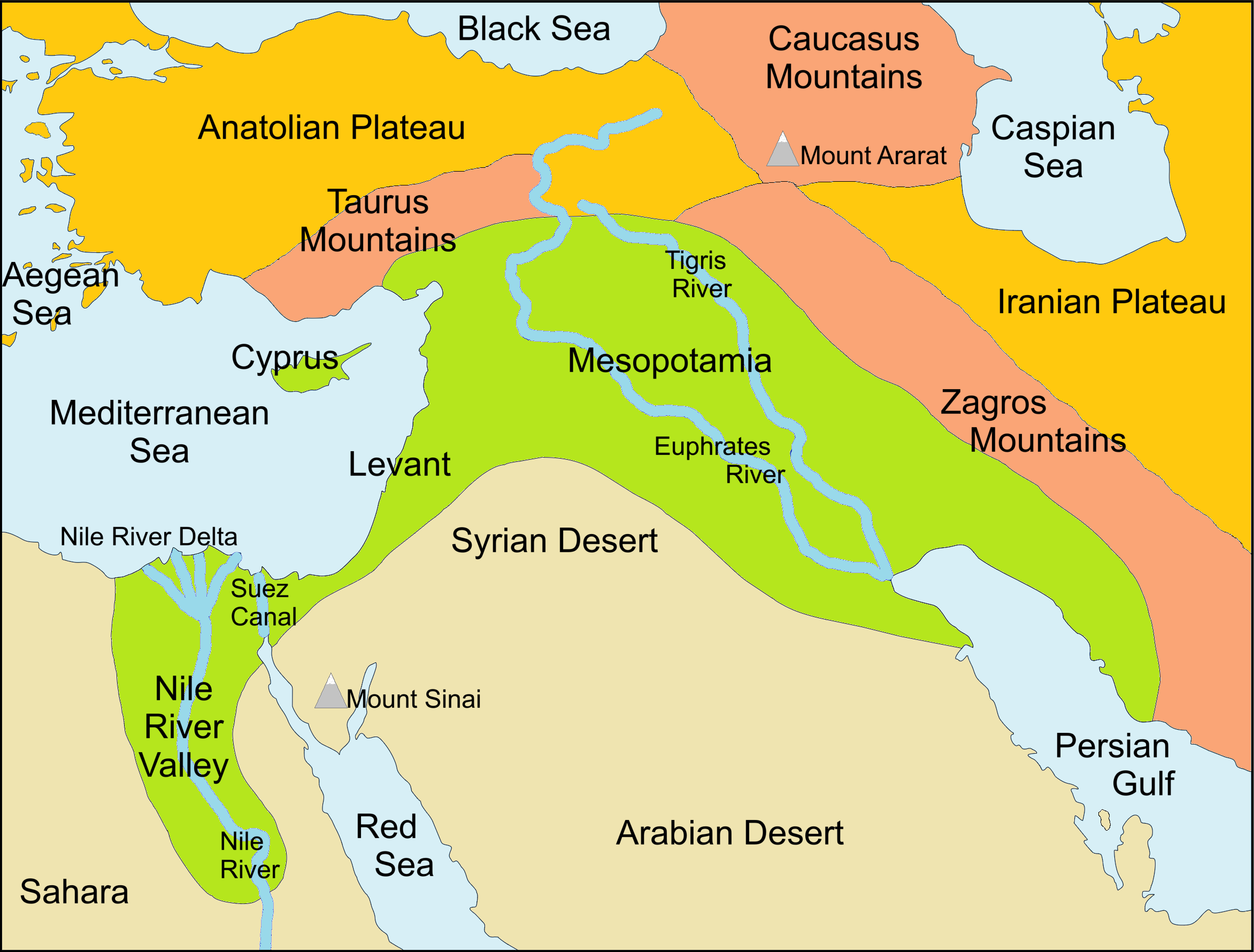
- Fertile Crescent: A large area of land in the Middle East that is shaped like a crescent on a map. It runs from the Persian Gulf, along the Tigris and Euphrates rivers, over to the Mediterranean Sea, and down the Nile River Valley of Egypt.
- Crescent: A curved, thin shape that is wider in the middle and tapers to points at each end, similar to the shape of a banana or of the moon in its first or last quarters. Can be a type of roll that is similar to, but different from, a croissant.
- Fertile: The ability to produce a large amount of offspring, new growth, or vegetation. It is used to describe both living things that can reproduce and land that is rich in nutrients.
- River: A natural waterway. They are good for civilizations as a source of water for drinking, crops, livestock, and washing; also a good source of silt for farming, mud for building, transportation for travel and trade, as well as fishing.
- Mesopotamia: The lands between and near the Tigris and Euphrates Rivers. It’s mostly located in present day Iraq and Syria.
- Nile River Valley: The agricultural area along the Nile River in Egypt. Part of the Fertile Crescent.
- Levant: The region on the eastern shore of the Mediterranean Sea, which in ancient times was Canaan, before the Israelites conquered it. In modern times this region includes Syria, Lebanon, Israel, and Jordan. This region’s name comes from the French and Italian words that mean “rising” or “the East,” referring to the lands where the sun rises. For followers of Judaism and Christianity this region can also be called the Holy Land.
- Cyprus: A large island in the eastern Mediterranean Sea, known for its strategic location and as a source for copper to make bronze.
- Euphrates River: The western and longer of the two great rivers. It also flows from the mountains down to the Persian Gulf, providing the main source of irrigation for the earliest cities.
- Tigris River: The eastern of the two great rivers that define Mesopotamia. It flows from the mountains in Anatolia (modern Turkey/Türkiye) down to the Persian Gulf.
1.3 Natural Barriers
-
- Natural barrier: A geographic feature like deserts and mountains that make travel and invasion difficult.
- Desert: A dry area of land, usually covered with sand or rocks, where very little rain falls and few plants grow.
- Xerophyte: A type of plant that can live in a desert, like a cactus. (But cactus are native to the Americas, not the Old World.) Old World examples include date palms, acacia trees, and the ghaf tree.
- Syrian Desert: A large, mostly rocky and dry desert that covers parts of Syria, Jordan, Saudi Arabia, and Iraq, acting as a natural barrier between the Mediterranean coast and Mesopotamia.
- Plateau: A large, high, and mostly flat area of land that rises sharply above the surrounding land on at least one side, like a mountain with its top chopped off – a “tableland”.
- Anatolian Plateau: The high, flat region in the center of the Anatolian Peninsula, surrounded by mountains.
- Iranian Plateau: A high-altitude area, or “tableland,” surrounded by mountain ranges, generally arid (dry) landform located in ancient Persia (modern Iran).
- Caucasus Mountains: A mountain range at the border of Europe and Asia, between the Black Sea and the Caspian Sea. White people are called Caucasian due to the old (mistaken) theory that they originated in this mountain range.
- Taurus Mountains: The mountain range that is the source of the Tigris and Euphrates Rivers, whose snowmelt provided water for the region’s agriculture. Named for the Greek word for bulls.
- Zagros Mountains: A mountain range in southwestern Iran that serves as the natural, rugged barrier separating the plains of Mesopotamia from the Iranian Plateau.
1.4 Seas
-
- Sea: A large body of saltwater, smaller than an ocean, often partly surrounded by land.
- Mediterranean Sea: A large sea connecting Europe, Asia, and Africa. It was the main trading route for many ancient civilizations.
- Red Sea: A sea inlet of the Indian Ocean, lying between Northeastern Africa and the Arabian Peninsula. It’s usually a vibrant blue-green, but gets its name from occasional blooms of reddish-brown algae.
- ABC Seas: The Aegean Sea, Black Sea, and Caspian Sea happen to line up in order from west to east (left to right on a standard north-is-up map), along the northern side of the Middle East.
- Aegean Sea: An arm of the Mediterranean Sea located between the coasts of Greece and Anatolia. This sea is filled with hundreds of inhabited islands, and many hundreds more that are uninhabited.
- Black Sea: A large inland sea that is bordered by Anatolia (modern Turkey/Türkiye) to the south and by Eastern Europe to the north. It isn’t actually black; its color varies, but it often appears dark due to severe winter storms, depth, and high hydrogen sulfide content.
- Caspian Sea: The world’s largest inland body of water, situated between Europe and Asia. While it is called a “sea” because of its size and salt water (only one third as salty as oceans and regular seas), it is technically classified as the world’s largest lake because it is completely surrounded by land (landlocked) and has no natural outlet to any ocean.
- Gulf: A part of an ocean or sea that stretches far inland, like a big arm of water surrounded by land on most sides, often bigger than a bay.
- Persian Gulf (Arabian Gulf): A shallow arm of the Arabian Sea, located between Iran (Persia) and the Arabian Peninsula.
- Persian Gulf – Ancient Coastline: The Persian Gulf coastline was significantly further north in ancient times—peaking around 6,000 years ago—primarily due to post-glacial sea-level rise and subsequent sediment accumulation.
2.0 Religion
2.1 Spirituality
-
- Spirituality: A person’s internal sense of connection to something bigger than themselves, such as nature, the universe, or a higher power. It is more about a personal feeling than following a specific set of rules.
- Morality: The internal sense of what is right, fair, and good. While ethics are often the rules a group follows, morality is the personal value system that guides how an individual treats others and makes choices.
- Belief: The feeling of being certain that something is true or that it really exists, even if you cannot see it or prove it with science.
- Religion: An organized system of beliefs, ceremonies, and rules used to worship or show reverence of a god or a group of gods, or of superhuman power or powers. It usually involves a community of people, shared stories, and specific buildings like temples or churches.
- Secular: Relating to the non-religious, non-spiritual physical world and material things (like money, clothes, and fame). Also called worldly or temporal.
- Tolerance: The ability to accept and respect the feelings, habits, or beliefs of others, even if they are different from your own.
- Persecution: The unfair or cruel treatment of a person or a group of people, often because of their religious beliefs, race, or background.
- Ignorance: A lack of knowledge, education, or information about a specific topic. In history, ignorance about how nature worked (like why it thunders) often led people to create myths to explain it.
- Fear: A powerful emotion caused by believing that something or someone is dangerous, likely to cause pain, or a threat. Many ancient religions used fear of the gods’ anger to make sure people followed the laws.
- Superstition: A belief that certain actions or objects can bring good or bad luck based on magic rather than reason or facts (like thinking a black cat is “bad luck”).
2.2 Polytheism
-
- Polytheism: The belief in many gods. Mesopotamians worshipped many different gods and goddesses, believing they controlled aspects of nature and their lives.
- Deity: A god or goddess. (Plural: deities.)
- Deify: To worship, consider, or treat someone or something as a god or goddess.
- Patron deity: The specific god or goddess believed to be the special protector of a single city-state or group of people. For example, Marduk was the primary god of Babylon.
- Pantheon: All the gods and goddesses of a particular religion or mythology. The Mesopotamian pantheon was vast, with thousands of gods, goddesses, and other spirits.
- Ziggurat: A large temple usually located at the center of a Mesopotamian city. They looked like step pyramids with a flat top. They were used to worship their gods and goddesses.
- Syncretism: A process by which two or more religious beliefs or doctrines were fused into one; an attempt to reconcile different beliefs into a new one that synthesizes them.
- Mythology: A collection of traditional stories (myths) belonging to a particular culture or group, often passed down through generations, to teach values and morals, and to explain things people didn’t understand, such as the creation of the world and natural phenomena (thunder, seasons). There were many myths in Mesopotamian culture. They took the form of hymns, tales and epics. Among the most famous are the Gilgamesh Epic, the Erra Epic, the Descent of Ishtar to the Underworld, Atra-hasîs, the Myth of Anzû, the Etana Epic, and the Creation Epic.
- Enuma Elish: The Babylonian Epic of Creation. This Babylonian literary text was composed at the end of the 2nd millennium BCE. It tells of the origin of the world and the appearance of gods and men. Initially, there were only two entities: Tiamat, salt water, and Apsû, fresh water. The other gods are descended from them. The epic describes the conflicts that arose between the gods and Marduk’s victory in a cosmic battle against Tiamat. Marduk then used Tiamat’s body to create the world, and incited his father Ea to create mankind (in older literary texts, Ea created man). This poem to the glory of Marduk explains his status as king of the gods, which he acquired at the end of the 2nd millennium BCE, and which mirrored the growing political influence of the city of Babylon in Mesopotamia.
- Shedu & Lamassu: Shedu: A creature in the Mesopotamian-influenced mythology of the Assyrians and Babylonians, a type of guardian spirit depicted as a winged bull or lion with a human head. Originally the male counterpart of a lamassu. Lamassu: Assyrians envisioned a protective spirit that was part bull and part human (and sometimes part eagle). Initially feminine, this spirit came to be seen as male, with a nice, long Assyrian beard.
2.3 Deities
Sumerian name of deity (Akkadian/Babylonian name of that deity)
-
- An (Anu): Mesopotamian god of the sky and the supreme sky god in Sumerian mythology. He was the father of the gods and the king of the divine assembly, with his name meaning “heaven”. Secondary patron god of the Sumerian city of Uruk.
- Enki (Ea): Mesopotamian god of subterranean fresh waters, wisdom, crafts, creation, magic and incantations. Patron god of the Sumerian city of Eridu.
- Enlil (Elil): Mesopotamian god of wind, air, earth, and storms; and the chief of all the gods. The Sumerians envisioned Enlil as a benevolent, fatherly deity, who watches over humanity and cares for their well-being.
- Humbaba (Huwawa): The fearsome guardian of the Cedar Forest of Lebanon, encountered by the hero Gilgamesh.
- Inanna (Ishtar): Goddess of love and war in the Mesopotamian pantheon. Daughter of the sun god Shamash. Primary patron deity of the Sumerian city of Uruk.
- Marduk: The primary god of the Babylonians. Patron deity of the city of Babylon.
- Nanna (Sin): Mesopotamian god of the moon, wisdom, and agriculture. Patron god of the Sumerian city of Ur.
- Ninsun: “Lady of the Wild Cows,” was a goddess in ancient Mesopotamian mythology, best known as the mother of the hero Gilgamesh and wife of deified legendary king Lugalbanda, as well as being known for her wisdom and nurturing nature. Patron deity for the Sumerian city of Lagash.
- Tiamat: The primordial goddess of saltwater and chaos in ancient Mesopotamian mythology, who gave birth to the first gods and was later killed and divided by the god Marduk to form the heavens and the earth.
- Utu (Shamash): Mesopotamian sun god of justice; known for giving Hammurabi his law code.
2.4 Magic
-
- Magic: The use of special words, rituals, or objects to influence events or communicate with spirits. It was often used for healing or protecting against demons.
- Amulet: A small object, charm, or piece of jewelry that Mesopotamians wore or kept to protect themselves from evil, sickness, or bad luck.
- Curses: Curses were inscribed at the end of the contract to bring misfortune to anyone who challenged the decision or damaged the stela. Curses invoked the power of the gods, who could unleash the forces of evil against anyone who did not respect the terms of the contract. There were also rituals to break curses placed on individuals
- Disaster: An event causing great damage or suffering (like floods, droughts, or war). Mesopotamians often believed these were caused by angry or displeased gods.
- Divination: The interpretation of the will of the gods, not only in the future and present, but also in the past, if someone wished to find the cause of a given situation.
- Exorcism: In ancient Mesopotamia, a ceremony of ritual gestures, incantations, rituals, potions, and sometimes herbal remedies intended to ward off evil by calling on the help of the gods. They were used to treat illnesses, avert bad omens, protect against financial loss and nurture romantic relationships. Exorcists claimed their knowledge was handed down to them by the gods Ea and Asalluhi.
- Incantation: A series of words said or sung as a magic spell or charm, used to invoke or call upon a spiritual power.
- Omen: A divine sign from the gods that predicted future events, ranging from the mundane to the government level.
- Ritual: A set of gestures and words spoken in religious ceremonies and which follow strict rules. Only specialists could perform these.
- Sacrifice: An offering (often food, animals, or valuable goods) made to a deity (god or goddess) as a way to honor them, ask for a favor, or calm their anger.
3.0 Achievements
3.1 Agriculture
-
- Agriculture: Growing plants and raising animals for human use, providing us with food and other products. It involves cultivating (preparing) soil to grow crops, like vegetables and grains, and raising animals for food, wool, and other materials. This practice has allowed human populations to grow into towns and cities by creating a stable supply of food, beverages, and fiber for clothing.
- Agricultural Revolution: A major change in human history when people transitioned from a life of hunting and gathering to one of settled farming and food production.
- Arable: Land that is suitable for growing crops.
- Crops: Plants grown by humans for food and drink, feed for livestock, fiber, vegetable oil, decoration, medicine, and biofuel (like burning wood for heat).
- Domesticate: To tame wild plants or animals for human use. By selecting the best seeds or the gentlest animals, people changed them to better suit human needs.
- Livestock: Farm animals (such as cattle, sheep, and pigs) that are kept, raised, and used by people.
- Pasture: Land covered with grass where livestock can graze. A related word is pastoral, which means something that relates to shepherds, rural country life.
- Plow (or plough): A tool invented in Mesopotamia for turning over and breaking up soil before planting seeds. Using a plow (often pulled by an ox) made farming much faster and more efficient.
- Surplus: An amount of something that is more than what is needed. A food surplus meant that not everyone had to farm, which led to specialization.
- Yield: The amount of agricultural product, such as grain, fruit, or vegetables, harvested from a specific unit of land area, typically measured in units like bushels per acre.
3.2 Irrigation
-
- Irrigation: Watering crops through human-made efforts such as ditches and canals.
- Canal: A long, human-made channel or ditch dug into the ground to transport water from a source (like a river or reservoir) to a farm field.
- Dam: A large barrier constructed to hold back water.
- Ditch: A narrow trench dug in the ground, typically used to drain water or to irrigate crops on a farm.
- Drought: A long period of time when an area receives significantly less rainfall than normal, leading to severe water shortages and crop damage.
- Floodplain: The flat land near a river that is subject to flooding.
- Levee: A wall of earth built to prevent a river from flooding its banks.
- Reservoir: A large, often human-made lake or basin built to collect and store water for irrigation and drinking.
- Salinization: The process where high levels of salt build up in the soil, often due to poor irrigation practices or using salty water. Too much salt makes it hard for crops to grow.
- Silt: A mixture of rich soil and tiny rocks that the rivers deposited on the land after the yearly floods, making the land very fertile.
3.3 Civilization
-
- Civilization: An advanced state of human society marked by organized cities, government, art, science, and a system of writing.
- City-state: An independently governed region that is centered around a single powerful city. The civilization of the Sumer was governed by many independent city-states.
- Clay tablet: The primary surface for writing in Mesopotamia, used for everything from accounting and legal documents to literature like the Epic of Gilgamesh.
- Code of Hammurabi: A written code of law from 1772 BCE. It was put in place by Babylonian King Hammurabi. It is one of the oldest detailed recordings of a code of law in world history.
- Cradle of Civilization: A term used for the areas, especially Mesopotamia and the surrounding Fertile Crescent, where early human civilizations first developed.
- Cuneiform: The earliest forms of writing. It was invented by the Sumerians. It uses wedge shaped marks to make picture symbols on clay tablets.
- Cylinder seal: An engraved stone cylinder used to create a seal or signature on clay tablets.
- Scribe: A person trained in writing cuneiform script. They were well-respected in Mesopotamian society.
- Stylus: A writing tool made from a reed that scribes used to make wedge shaped symbols on clay tablets.
- Sumer: The first human civilization in world history, it began to form towns in 5000 BCE.
3.4 Other Accomplishments
-
- Architecture: The art and science of designing and constructing buildings and other structures.
- Arch: An upside-down U-or V-shaped structure that supports weight above it, as in a doorway. Historians say that the invention of the arch is one of the Sumerian’s greatest architectural achievements.
- Arts: Human creative expression, including drawings, sculptures, music, dance, theater, literature, and crafts.
- Astronomy: Using their advanced math, the Mesopotamian astronomers were able to follow the movements of the stars, planets, and the Moon. One major achievement was the ability to predict the movements of several planets. This took logic, mathematics, and a scientific process.
- Chariot: The chariot was a two wheeled vehicle pulled by horses. It was typically used for warfare and was one of the strengths of the Assyrian army.
- Culture: A group of people’s shared, learned characteristics, including language, religion, food, clothing, arts, recreation, family structure, and traditions.
- Lyre: A stringed instrument shaped like a small harp.
- Mathematics: The Mesopotamians used a number system with the base 60 (like we use base 10). They divided time up by 60s including a 60 second minute and a 60 minute hour, which we still use today. They also divided up the circle into 360 degrees.
- Weaving loom: A device for creating cloth from threads, typically with a simple wooden frame.
- Wheel: Although archeologists don’t know for sure who invented the wheel, the oldest wheel discovered was found in Mesopotamia. It is likely the Sumer first used the wheel in making pottery in 3500 BCE and then used it for their chariots in around 3200 BCE.
4.0 Politics
4.1 Peoples
-
- Mesopotamians: The ancient peoples who lived in Mesopotamia (the “land between two rivers,” the Tigris and Euphrates, in modern-day Iraq). They included Sumerians, Elamites, and Semitic peoples, such as Akkadians, Babylonians, and Assyrians.
- Sumerians: The first known people and language in Mesopotamia, the language was spoken by the Sumerian people who occupied southern Iraq in the 3rd millennium BCE. The cuneiform writing system was used to write the Sumerian language and then Akkadian. Sumerian is not related to any other known language.
- Elamites: Language and culture of Elam, modern southwest Iran. This non-Semitic language does not belong to any large known linguistic group. It has yet to be deciphered, but is partly understood through ancient transcriptions in cuneiform. Their main city was Susa.
- Semitic peoples: Several related Afro-Asiatic Middle Eastern peoples and languages who are divided into several subgroups: Eastern Semitic (Akkadian, including Babylonian and Assyrian); Northwestern Semitic (Ugaritic, Aramaic, and Canaanite, with Phoenician and Hebrew being part of the latter); and South Semitic (Arabic, South Arabian, and Ethiopian).
- Akkadian: The language of the Babylonians and the Assyrians. Also the name of an ancient Semitic language-speaking people of southern Mesopotamia. Their language replaced Sumerian as the primary language.
- Amorites: An ancient Semitic language-speaking people who originated in western Syria and expanded to control large parts of Mesopotamia and Canaan during the Early Bronze Age.
- Anatolians: An ancient Indo-European language-speaking peoples who lived in the region of Anatolia (modern Turkey/Türkiye).
- Hittites: The Indo-European ancient Anatolian people who created a large empire and were one of the first groups to use iron extensively for tools and weapons.
- Greeks: The Indo-European people from the ancient civilization that developed on the peninsula of Greece and its surrounding islands, famous for democracy, philosophy, and mythology.
- Phoenicians: An ancient sea-trading people from the Levant coast (modern-day Lebanon) who were famous for their ships, purple dye, and for developing one of the first alphabets. They were a Canaanite-related people, part of the Semitic peoples.
4.2 City-States
-
- Göbekli Tepe: An extremely old archaeological site in Anatolia (modern Turkey/Türkiye) with huge stone pillars. It is famous because it was built by hunter-gatherers before farming began, changing what we know about early human history.
- Çatalhöyük: A very large and old Neolithic town (one of the world’s first) in Anatolia (modern Turkey/Türkiye). People there lived in houses built right against each other, and they entered their homes through the roof.
- Uruk: Considered the world’s first true city. The city is credited with the invention of writing around 3200 BCE. Said to be the capital of Gilgamesh. Patron deity was Inanna (Ishtar).
- Ur: An important Sumerian city-state in ancient Mesopotamia, located in modern Iraq. Known for being the birthplace of Abraham. Primary patron deity was Nanna (Sin); secondary patron deity was An (or Anu).
- Akkad: An ancient city and empire in Mesopotamia (modern-day Iraq) that was one of the world’s first large empires, founded around 2300 BCE.
- Babylon: A famous, powerful ancient city on the Euphrates River in Mesopotamia. It was the capital of the Babylonian Empire and was known for its wealth, towering walls, and culture. Marduk was the patron deity.
- Assur (Ashur): The original capital city of the Assyrian Empire. It was also the name of the primary god in the Assyrian religion.
- Nineveh: Assyrian city occupied as early as the 8th millennium BCE. Sennacherib (704-681) made it his capital and extensively rebuilt the city. Ishtar was the primary patron deity.
- Susa: This Elamite city was located in the southwest of present-day Iran. It has been occupied since 4200 BCE.
- Hattusa: The fortified capital city of the Hittite Empire in ancient Anatolia (modern Turkey/Türkiye). It was surrounded by massive stone walls and gates.
4.3 Empires
-
- Empire: A large number of states or regions that are ruled by a single leader called the emperor or empress.
- Akkadian Empire: The Akkadian Empire was the world’s first empire. It formed when Sargon the Great conquered many of the Sumerian city-states and united them under one leader.
- Assyrian Empire: An empire known for their fierce warriors, the Assyrian Empire rose and fell several times to rule over much of Mesopotamia and the Middle East.
- Babylonian Empire: The Babylonian Empire ruled much of Mesopotamia from the city of Babylon. The empire rose and fell over the course of ancient history.
- Dynasty: When one family rules a kingdom or empire for a period of time, passing down the reign to the next generation.
- Hellenistic: A period of history when Greek culture and ideas spread across the Middle East, North Africa, and Asia after the conquests of Alexander the Great.
- Monarchy: A form of government where the ruler (king or queen) inherits power. Most city-states in Mesopotamia were ruled by kings.
- Mount Ararat: A large, snow-capped volcanic mountain in eastern Anatolia (modern Turkey/Türkiye), which is mentioned in the Bible as the landing spot of Noah’s Ark.
- Mount Sinai: The mountain in Egypt where, according to the Bible, Moses received the Ten Commandments from God.
- Troy: An ancient city in Anatolia (modern Turkey/Türkiye), famous as the setting of the Trojan War in Greek mythology, where a large wooden horse was used to sneak soldiers into the city.
4.4 Rulers
-
- Gilgamesh: A legendary hero and king of Uruk who was the protagonist of the famous Epic of Gilgamesh. Ruled in the first half of the 3rd millennium BCE and is mentioned in the Sumerian king list.
- Sargon of Akkad: King of Sumer and Akkad. His reign had a considerable influence on the policies adopted by many Mesopotamian rulers.
- Enheduanna: The high priestess of the moon god Nanna in the Sumerian city-state of Ur in the reign of her father, Sargon of Akkad. The earliest known named author in world history, including the Exaltation of Inanna, the Hymn to Inanna, the Temple Hymns.
- Ur-Nammu: The founder of the Third Dynasty of Ur. Known for his significant building projects and his law code, one of the oldest surviving law codes in history.
- Hammurabi: A famous king of the Old Babylonian Dynasty; known for his comprehensive code of laws, known as the Code of Hammurabi.
- Nebuchadnezzar II: Famous ruler of the Neo-Babylonian Empire, known for conquering Jerusalem and initiating the Babylonian Captivity, and for his magnificent construction projects that transformed Babylon into a magnificent ancient city, including the Ishtar Gate.
- Sennacherib: King of the Neo-Assyrian Empire known for his ruthless military campaigns, particularly against Babylon and Judah, his ambitious building projects, including the construction of the city of Nineveh, and his role in Ashurnasirpal’s biblical story as the king whose army besieged Jerusalem.
- Ashurbanipal: King of the Neo-Assyrian Empire famous for establishing the Library of Nineveh, the most extensive collection of Mesopotamian knowledge known, and for being a highly learned Assyrian king who could read and write. He also achieved significant military successes, expanding the Assyrian Empire to its peak by conquering enemies like Elam and Egypt.
- Alexander the Great: The famous Macedonian Greek leader known for creating the largest ancient empire, stretching from Greece to India, and for spreading Hellenistic culture throughout this vast territory. He was a brilliant military commander, never losing a single battle, and successfully conquered the Persian Empire. His campaigns and the subsequent Hellenistic Age profoundly changed the course of history, influencing culture and connecting East and West.
- Seleucus I: Greek general and then successor to Alexander in the East. He founded the Seleucid Empire.
5.0 Economy & Society
5.1 Social Hierarchy
-
- Social hierarchy: A system ranking people or groups in a society, granting some more status, power, or privilege than others, often based on wealth, education, occupation, gender, or birth.
- Job specialization: Specified what job you were good at (ex. building, weaving, etc. helped contribute to ancient civilizations).
- Middle class: People who included artisans, merchants, and skilled workers who kept the city functioning.
- Merchants & Traders: People who transported surplus (extra) agricultural goods, raw materials, and manufactured crafts—such as wool, leather, and pottery—between city-states and foreign civilizations to exchange them for essential resources that the region lacked, such as lumber, metals, and precious stones.
- Artisans: Crafts people who included weavers, potters, metalworkers (jewelers, silversmiths), carpenters, and brickmakers, creating functional and decorative goods.
- Bazaar: A marketplace.
- Lower class: The largest group in society, primarily made up of farmers, herders, fishers, and manual laborers who provided food and raw materials.
- Farmers: People who grew crops like barley, wheat, dates, and legumes; they also kept livestock (farm animals), such as oxen and donkeys.
- Herders: People who managed sheep and goats for wool, milk, and meat; their communal labor built large irrigation systems and other large construction projects.
- Enslaved persons: People in ancient times held in involuntary servitude, taken from war captives, debtors, criminals, or orphans, serving in households, temples, and large projects, not based on race; many had rights to property, could marry, engage in business, and even buy freedom.
5.2 Elites
-
- Upper class: Powerful and wealthy group including the royal family, nobility, high-ranking government officials, and military leaders – the elites.
- Stratified society: A society where people are organized into layers (strata) based on wealth, power, and influence.
- King: A ruler seen as earthly representatives of the gods, responsible for providing justice, protecting their people, and ensuring proper worship. Their roles and power evolved over time, from early priest-kings to powerful conquerors and empire-builders.
- Nobles: Members of the elite upper class, alongside royalty and high priests, holding power through land ownership, government/military roles (officials, commanders, scribes), and family ties, living lavishly and setting them apart from commoners, merchants, and slaves in a strict social hierarchy.
- Priests/priestesses: Members of the elite upper class who served gods, managed temples (which acted as economic centers), and performed medical and religious duties.
- Astrologers: Observed stars, developed calendars, predicted eclipses, and linked celestial events to gods.
- Hanging Gardens of Babylon: One of the seven wonders of the world according to ancient Greek authors. No trace of these gardens has been found in Babylon, either in the texts or in Neo-Babylonian art. They may actually have been in Nineveh, where the creation of royal gardens is well documented.
- Library of Nineveh: The ancient Library of Ashurbanipal, a vast collection of cuneiform tablets housed in the city of Nineveh (modern-day Iraq).
- Siege weapons: Weapons used to capture cities and take down walls. The Assyrians were experts at using siege weapons such as battering rams and siege towers.
- Soldiers: People who provided defense and supported military expansion.
5.3 Metals
-
- Metal: An element or mixture of elements that is typically hard, shiny (lustrous), and acts as a good conductor of heat and electricity, such as common elements like iron, copper, aluminum, gold, silver, tin, and zinc, along with alloys such as steel and bronze, and less common elements like titanium and platinum.
- Metallurgy: In Mesopotamia, metal was used for the production of tools and weapons, but also figurines, amulets, and jeweler, as well as ceremonial pieces.
- Quarry: A place, typically a large, deep pit, from which stone or other materials are or have been extracted. Due to a general lack of stone, Mesopotamian cultures like those in Sumer and Babylon relied heavily on imported stone and were known for their extensive use of clay for writing, pottery, and construction.
- Ore: A natural, solid material—usually rock with valuable minerals or metals—found below ground, that is mined or quarried, then refined through heat, chemicals, or electricity to separate the metal. Example ores include hematite (iron oxide mineral), bauxite (aluminum and gallium), chalcopyrite (copper ore), and galena (lead sulfide).
- Alloy: A human-made metal mixture, such as steel (iron + carbon), bronze (copper + tin), brass (copper + zinc), stainless steel (iron, chromium, carbon, etc.), sterling silver (silver + copper), white gold (gold + silver/palladium), and electrum (gold + silver).
- Copper: A soft, reddish-brown metal that was one of the first metals used by humans.
- Iron: Initially rare and hard to obtain, iron was regarded as a precious metal in the 3rd and 2nd millennia. It came into much wider use in the 1st millennium BCE.
- Bronze: A metal alloy (mixture) made mostly of copper and tin. It was stronger than copper and gave its name to the Bronze Age.
- Cubit: Unit of linear measure based on the length of the arm from the elbow to the tip of the middle finger, generally taken as equal to 50 cm. Cubit dimensions and subdivisions varied over time and according to the units of measure in use.
- Shekel & Mina: Shekel: A standard unit of weight first used in Mesopotamia. Mina: A unit of weight equal to 60 shekels or around 1.25 pounds.
6.0 Studies
-
- Ancient: Belonging to the very distant past. Ancient times ended around 476 CE with the fall of the Western Roman Empire in the West, though this date is a Western-centric convention, and the exact end date varies by region and historian.
- Anthropology: The study of people and cultures across the entire world and over all of time. Anthropologists want to know what makes us human, from our bones to our beliefs.
- Archeology: The study of old objects (artifacts) and sites to learn about how people lived long ago. Archaeologists are like detectives who dig up and study ancient tools, pottery, and buildings.
- Assyriology: A specialized study of the history, language, and culture of the ancient Mesopotamian civilizations in that used cuneiform writing. Cuneiform users included Sumerians, Akkadians, Babylonians, Assyrians, Hittites, Elamites, and other Mesopotamians.
- Geography: The study of the Earth’s surface, including its physical features (like mountains and rivers) and how people and their activities are spread out across it.
- Historical method: A process for gathering and evaluating physical remains, archaeological evidence, and primary and secondary textual sources.
- History: The study of past events, especially human affairs, often using written documents as main evidence to understand how things change over time.
- Primary source: An original document, object, or firsthand account created at the time of an event by someone with a direct connection to it, serving as “raw material” for research.
- Secondary source: A secondhand account that analyzes, interprets, or synthesizes information from primary sources and is not a direct, firsthand account of an event or topic.
- Tell: The Arabic word tell refers to an artificial mound formed by superimposed habitation layers, with each new occupation built on the ruins of the previous one. During excavations, archaeologists know that the lowest levels are the oldest and the upper levels the most recent.